Missed the beginning? Read Everest Base Camp Part 1: The Journey to Lukla
Lukla to Phakding: Day 1
After seven days of waiting, I was not going to waste a single hour in Lukla. We landed around 2:00 pm and met the team our travel agency had arranged: a guide from Lukla and two porters for our luggage. We grabbed a late lunch, and our guide suggested we push on to Phakding village, a three-to-four-hour walk away. Yes, please.
And just like that, after years of dreaming, I was standing 2,860 meters above sea level with a trail in front of me.
The weather that first day was not exactly postcard material. Heavy clouds wrapped around the mountains, and I kept thinking about how much more I was missing. Still, the mountains were so tall that the clouds could only cover part of them. The whole way to Phakding, I kept tilting my head back to find the top.

Our First Tea House in Phakding
We reached Phakding, 2,610 meters above sea level, and checked into one of the tea houses along the trail. Most of the lodging up here is like this: small, family-run places, bed and breakfast style, where trekkers eat, rest, and swap stories in a shared dining room at the end of the day. Simple but warm. Everything you need after a long day of travel.
After we freshened up, we headed to the dining room, and someone from the tea house staff put a hot lemon, honey, and ginger drink in my hands. After the airport wait, the flight, and the walk in the cold, it felt almost healing to wrap my hands around that warm cup. And it tasted sooo good. It became a ritual for the rest of the trip.
Dinner that night was dal bhat. At least for me.
If you are not familiar, dal bhat is a Nepali staple. Rice, lentils, stir-fried vegetables, greens, chutney, and meat if you want it. Simple, complete, and yummmm 😀 Growing up in Nepal, I took dal bhat for granted. I never really asked why, but maybe it was because it was always there. Then I moved to the US, and I missed it more than I ever imagined I would. Now I was the one cooking, and I was learning as I went. Nothing I made tasted like home. That’s when I realized how much time, effort, and love went into a fresh, made-from-scratch plate every single day.
On this trek, I did not just eat dal bhat. I devoured it every dinner and did not regret a plate.
My brother and mom ordered other things. I guess they hadn’t had to live without it. I forgave them 😀
Phakding to Namche Bazaar: Day 2
The next morning we headed to Namche Bazaar, one of the places I had been most excited about since I first started planning this trip.
I have done hikes before where you trudge uphill for hours and then, at the top, you get your reward: the view. This was nothing like that. The entire walk to Namche was the view. Layers of towering mountains in every direction, waterfalls crashing down cliffsides, rivers cutting through valleys far below.

The trail itself was a treat too. Mostly a dirt path, with long steady uphill stretches and a few downhill breaks. Along the way, we crossed the historic Hillary Bridge. After it came the climb I remember best, a long, steep stretch up what our guide said locals call Tohp Danda, where I was completely out of breath. Seven to eight hours after we set out, we reached Namche Bazaar.

Exploring Namche Bazaar
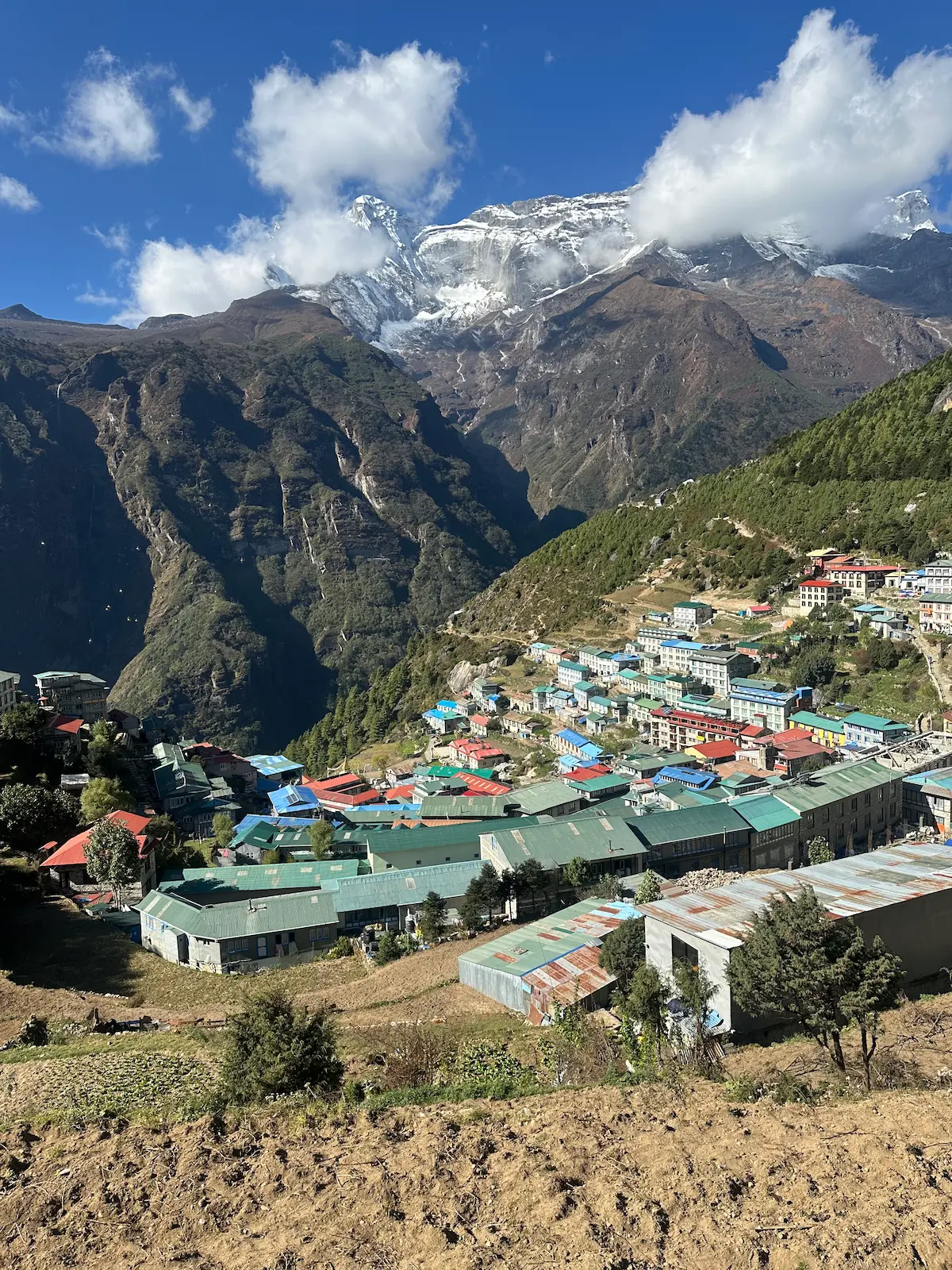
Walking into Namche, I could not stop looking around. On day one, I had spent the whole walk tilting my head back to find the tops of the mountains. Now I was turning it side to side: German bakeries, well-stocked gear shops, restaurants, and even an Irish pub, all at 3,440 meters above sea level. I had heard Namche was a hub for trekkers, but I never imagined it would be this well equipped. I kept wondering how any of this could exist this far into the mountains.
After a full day of walking, you would think we would have gone straight to bed after dinner. Nope. Namche was too alive to ignore. My brother and I headed out to explore and somehow ended up at the Hungry Yak, apparently the world’s highest live music bar. A glass of cabernet sounded perfect, but we’d heard alcohol and acclimatization do not mix. So, hot lemon with honey and ginger, obviously. Again. And there we were, listening to live music in a bar in the Himalayas. Not a sentence I ever expected to say.

Acclimatization Day: Hotel Everest View and Khumjung, Day 3
The following day was our rest day, also known as an acclimatization day. A rest day here does not mean no walking. It means covering less distance, but you still follow the rule of the trek: “hike high, sleep low.” Climb higher during the day, then descend to sleep below the highest point you reached, so your body can adjust to the thinning air. Our plan was to hike up to Hotel Everest View at 3,880 meters, then descend to Khumjung village at 3,790 meters, where we would spend the night.

The hike was supposed to take about four hours. It took us longer than that because we kept stopping. Mostly for photos, but with views like those, how could we not?

Our First View of Everest on the Base Camp Trek
About 45 minutes to an hour above Namche, we reached what our guide called the Sagarmatha View Point and got our first glimpse of Everest, or Sagarmatha, as it is known in Nepali!
I remember smiling so hard, ear to ear, that my mouth actually hurt.
Taboche, Nuptse, Lhotse, and Ama Dablam stood beside Everest, every one of them over 6,000 meters! To my surprise, Everest actually looked smaller than the peaks around it, maybe because of the angle or the distance. I kept looking from one to another with joy. Of course, I took a zillion photos and videos.

After a couple of hours of walking, and plenty of stops for photos, we reached Hotel Everest View, known for its panoramic views of the Himalayas. This was the highest point we would reach that day. We found a spot and sat for a while, with Everest and the surrounding peaks right in front of us. Then we began our descent into Khumjung.
Khumjung Village and the Hillary School
Khumjung isn’t on the main Everest Base Camp trail. Many trekkers go up to Hotel Everest View and head back down to Namche on their acclimatization day. But Khumjung was part of the itinerary our agency had planned, and I am so glad it was.
Known as the Green Valley, it is a small Sherpa village nestled at the foot of the sacred Mount Khumbila, surrounded by mountains. The nickname makes sense the moment you arrive: nearly every traditional stone house has a rooftop painted the same shade of green. Namche was vibrant and surprising. Khumjung was gentle and slow. After the buzz of Namche, it felt like the mountains were exhaling.

My mom is a teacher, so she had wanted to visit the Khumjung Secondary School, better known as the Hillary School. Sir Edmund Hillary helped build it after his Everest summit, and it was the first school he built in the region. The welcome center told the story of how the school came to be and how its alumni had gone on to build successful careers, from doctors to government officials and more.
I had no idea how much Sir Edmund Hillary had done for this area and its people until then. The Himalayan Trust he founded went on to build more than two dozen schools in all, plus hospitals and the Lukla airstrip we had landed on.


I bought a couple of fridge magnets at the welcome center before we left. We had the afternoon to ourselves, so we strolled through the village, and I wandered into a small shop selling handmade goods. Fridge magnets were not enough, apparently 😀 I found ear warmers too good to leave behind, so I got one for myself and one for my sister back home.
That evening, after dinner, the tea house owner, who was warm and chatty, ended up joining us for Call Break, a card game popular across South Asia. He won. Twice. Home-court advantage is real, even at 3,790 meters 😀 It wasn’t part of the plan, but it was one of my favorite parts of the day.
After those first few days, I was finally starting to feel comfortable on the trail. The nervousness I’d carried with me to Lukla was slowly fading. Okay, I thought. I am actually doing this.
Leave a Reply